
- News
- City News
- bengaluru News
- The butterflies have landed
Trending
This story is from August 22, 2017
The butterflies have landed
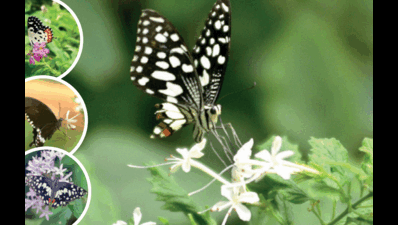
New breeding techniques and special conservation programmes have paid off — there is a rise in the number of butterflies at the park.
(This story originally appeared in  on Aug 22, 2017)
Good news for butterfly-watchers. After years of a ‘butterfly drought’, there is a spurt in the number of these insects at the Butterfly Park of the Bannerghatta Biological Park (BBP). on Aug 22, 2017)The park had thousands of butterflies, but in the past few years, just a few hundreds of butterflies remained. New breeding techniques and special conservation programmes adopted by BBP officials have paid off as, for the first time in years, there is a rise in the number of butterflies at the park.

When the park was started in 2006 on close to eight acres, it had more than 1,000 butterflies of 20 species. But until a few months ago, the count had reduced to a few hundreds. A count revealed the park now has more than 2,500 butterflies.
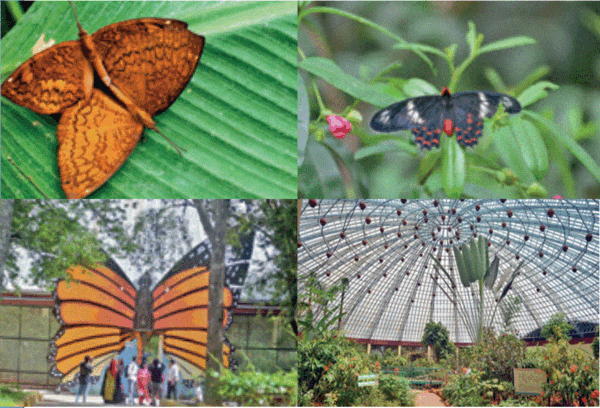
Santosh Kumar, executive director, BBP, said, “We have taken special measures to increase the numbers. Weather has also been kind. As a result, for the first time, the park will have more than 20 species of butterflies with their numbers exceeding 2,500.”
Sources at the Butterfly Park said that earlier the park had more bushy plants rather than flowering ones. “While butterflies lay their eggs on the leaves of the host plant, they can be attracted only by flowering plants. Hence more and more flowering plants were planted around the park,” said a curator at the park.

Puneeth T, a regular visitor to the park, said, “There is no other place in the city where one can see and understand the entire life cycle of a species. I have been visiting the park often with my children. During their summer holidays, there were hardly any butterflies. But post-monsoon, there has been a spurt in their numbers.”
Lokanath V, entomologist at the Butterfly Park, explained to BM what went right. “We have a separate room where we breed butterflies and it is an on-going process.
We have been following this since the beginning, but recently we started experimenting with breeding of different species. Climatic conditions have been beneficial.
In summer we witness very few butterflies because of the high temperature, but now the temperature is just right for the breeding process.”
“Butterflies are known as bio-indicators. In summer, their life span is about 15 to 20 days and the count was less. We had only about 400 butterflies. Now the count has risen and they include the Blue Mormon (state butterfly of Maharashtra) which is the second-largest butterfly in India.”
End of Article
FOLLOW US ON SOCIAL MEDIA










Hot Picks
TOP TRENDING
Trending Stories
In City
Entire Website
- 10 things to know about 'Black Epstein' Sean 'Diddy' Combs
- 10 Common Habits That Could Be Hindering Your Success
- Jerry Jones Give 4 Words Reply While Defending Cowboys’ Decision Not to Sign Derrick Henry
- 'Oh my God': Tom Brady's Frustration Clearly Evident in Cowboys' Struggles Against Ravens
- Who is Anura Kumara Dissanayake, Sri Lanka's new president
- Early-century Lord Ganesha, Buddha statues: Images of stolen antiquities US handed over to India during PM Modi's visit
- 'My daughter would have been dead by now': When a ‘monkey attack’ in UP foiled man’s bid to rape 6-year old girl
- 'Will kill them and ...': Israel, Hezbollah vow to intensify cross-border attacks
- Ex-Google employee looking for job in Canada: “I've been reducing my India experience on my resume because …”
- How India prices of iPhone 16 series compare with that in the US, Canada, Singapore and Dubai
- This ‘family’ stayed together & trafficked together: How police caught them
- Israel says expanding strikes against Hezbollah 'weapons sites'
- Rahul has reopened the wounds of 1984 instead of healing them
- Maharashtra govt approves renaming of Pune airport to 'Jagadguru Sant Tukaram Maharaj' airport
- EY employee death: Backlash mounts as Sitharaman's remark sparks outrage
- Watch: Shivraj Singh Chouhan's car gets stuck in pothole in Jharkhand
- As Sri Lankans swing left, will India get another hostile neighbour?
- iPhone 16 series record sales on Day 1 in India, could help Apple to set milestone
- Hindus who fled to J&K from Pak to vote for 1st time since 1947
- Bengaluru woman murder case: Police identify ‘outsider’ as prime suspect

Popular Categories
Hot on the Web
Top Trends
Radhika GuptaEY Employee DeathRishabh PantIsrael Hezbollah WarNvidia CEO Jensen HuangAnura Kumara DissanayakeJetblue Flight Emergency LandingPM Modi with Tech CEOAwadhesh PrasadUGC NET Result LiveBengaluru Mahalakshmi MurderRohit SharmaStolen Antiquities USShoaib AkhtarTirupati LadduPM Modi US VisitLive Cricket Score
Trending Topics
Living and entertainment
Latest News
EC team in Jharkhand to review poll preparednessElon Musk's SpaceX to send uncrewed Starships to Mars by 2026: “One of my biggest concerns right now..”Ghosts Season 4: Premiere date, plot, and cast revealedWhat is the 30-30-30 weight loss method? How to do it for maximum benefits?Mom's everyday tips were a must for golden boy D GukeshYudhra Box Office: Siddhant Chaturvedi starrer earns only Rs 8.60 crore over the weekendKaun Banega Crorepati 16: Amitabh Bachchan praises Ujjwal’s resilience as he attempts the 1 Crore questionOlivia Munn and John Mulaney welcome second daughter via surrogateNaseeruddin Shah, Ratna Pathak Shah bring old world charm to DelhiBigg Boss Tamil 8: VJ Jacquline to participate in the upcoming season?Gen-Z slang words explained: 30 terms you need to knowThe truth about sugar substitutes: Safe alternative or hidden health risk?Kim Jung-nan chooses Song Joong-ki as most appealing actor, praising his care and leadershipDecomposed body of civil services aspirant found in DelhiGoogle CEO Sundar Pichai after meeting PM Narendra Modi in US: “He pushed us to continue..”Gemini, Daily Horoscope Today, September 23, 2024: Face financial strain today with expenses outpacing incomePisces, Daily Horoscope Today, September 23, 2024: Day marked by restlessness and a need for changeNolan Gould would make personalized ornaments for Modern Family castmates and crew each Christmas
Copyright © 2024 Bennett, Coleman & Co. Ltd. All rights reserved. For reprint rights: Times Syndication Service